Die analoge Plattenqualität messen - im Jahr 1984 - 1986
Da ist uns ein seltener dicker Wälzer - der 1986er Produktkatalog - von der dänischen Hightech-Meßgeräte- Schmiede "Brüel und Kjaer" vererbt worden. In der Beschreibung (man kann es fast schon einen Artikel nennen) über die Messungen an analogen Platten sowie an den Laufwerken steht zwischen den Zeilen, was im Jahr 1984 bei der analogen Schallplatte im günstigsten Fall machbar und meßbar sein konnte und könnte. Bei den allermeisten war die analoge Platte bereits "out".
.
Die neue CD stand vorerst (noch) in den Startlöchern .....
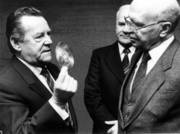
- Max Grundig 1981

Als Philips im Sommer 1979 diese neue Silber-Scheibe als digitale Schallplatte vorgestellt hatte, gingen die Spekulationen der von sich und ihrem "Wissen" eingebildeten Fachleute von "totaler Flop" bis "geniale Technik" diametral auseinander. - Karl Breh war einer der Wenigen, er war Diplom- Physiker, der auf Anhieb das Potential der CD erkannte und kommen sah und auf der richtigen Schiene lag. Die eingeladenen anderen Firmen und auch erstaunlich viele Redakteure sahen eine große Konkurrenz auf sich zukommen und suchten Wege, die analoge LP möglichst lange am Leben zu erhalten und vielleicht auch noch weiter zu verbessern.
Auch die alteingesessenen Meßgerätefirmen verfeinerten ihre Meß-Technik, um das letzte Quäntchen an akustischer Qualität aus der 33er LP herauzuholen und auch zu messen.
.
Es ist ein 830 Seiten Wälzer von Brüel & Kjaer aus 1986 ......
Brüel & Kjaer wollte und konnte da etwas anbieten, das die Grenzen der analogen Plattentechnik überprüfen konnte. Brüel & Kjaer arbeitete nämlich mit Ortofon (auch in Dänemark) zusammen, die mit ihren Audio-Geräten auch im oberen Hifi-Himmel agierten. Ortofon baute Plattenlaufwerke, Tonarme und Abtastsysteme und alles vom Feinsten. Auf das Niveau von DUAL mit den Billiggurken ließen die "Ortofoner" sich nie runter ziehen.
.
So entstanden in der Zusammenarbeit 3 Meßschallplatten für die jenigen, die ihre Geräte nachmessen wollten oder sogar mußten. Auch die BRAUN AG in Frankfurt baute hochwertige Edellaufwerke und die mußten überprüft werden.
Die Entwickler bei Brüel & Kjaer wußten natürlich, welche Eigenschaften bei einem Plattenspieler Einfluß auf die Qualität der Wiedergabe hatten. Und das waren ja gar nicht so viele Paramter, die da überprüft werden müssten. Und selbstverständlich muß zuallererst die Qualität der Meßschallplatte bis aufs letzte Quäntchen ausgequetscht werden.
.
Der Wälzer ist international - und natürlich auf Englisch
Für mich war es überhaupt schon erstaunlich, welche Mühe sich die Brüel & Kjaer Mannen mit diesem Buch gemacht hatten. Ich vermute nämlich in Deutschland West gab es keine 50 Firmen, die solche teuren Meßgeräte benötigten und auch kaufen konnten. Und weltweit waren es vielleicht 200 oder 250 Firmen, denn alleine die nordischen Staaten kamen insgesamt auf weniger als 10 Hersteller und 4 Rundfunkanstalten. Betrachten wir Frankreich, Spanien, Griechenland und Italien, sind (waren) es vielleicht nochmal 10 Interessenten. Alleine die USA und Kanada kämen auf mehr als 50 Firmen, und damals Japan nicht zu vergessen.
.
Welche Komponenten sind qualitätsbestimmend ?
Beginnen wir mit dem Lager des Plattentellers. Ist das senkrechte und das waagrechte Lager unvollkommen, rumpelt der Teller und er läuft nicht rund. Das sind für den Normalo nur Nuancen, die man aber messen kann und im Extremfalle sogar hören kann.
Erfolgt der Antrieb des Tellers über ein Reibrad oder einen Riemen oder einen elektronischen Direktläufer, gibt es jeweils andere Schwächen und die kann man auch messen.
.
Auch der Tonarm mitsamt seiner Lagerung und Geometrie hat Einfluß und natürlich auch das Abtastsystem mit nadelträger und Nadel. Zu diesen mechanischen Einzelheiten kommt noch die elektrische Übertragung dieser paar Millivolt bis zum ersten Vorverstärker hinzu.
.
Die "Wow and Flutter" Messung mit dem 6203
.
FEATURES:
■ Fully automatic with manual override. No tuning required
■ Meets DIN 45 507, IEC 386, CCIR 409 and IEEE 193
■ Measurement of flutter and drift down to 0,001 and 0,01% peak respectively
■ 3 Digit LED indication of % flutter range and % drift
■ Out of range indication
■ 0,3; 3 and 30s averaging for drift measurements
■ Weighted and linear modes with provision for connection of external filter
■ 3,1 5 kHz, quartz crystal, test source built-in
■ AC and DC outputs for level and XY recording
.
USES:
■ Laboratory, studio and production line measurement of flutter and drift with sound as well as video recording and reproducing equipment
■ Frequency analysis of flutter when used with external filter or analyzer
■ Fault detection and diagnosis for service and maintenance work
■ Early warning of equipment breakdown
.
Beschreibung :
The Wow and Flutter Meter Type 6203 is a small, easy to use instrument using analogue and digital techniques for measurement of peak flutter and drift of sound recording and reproduction equipment. Automatic selection of five meter ranges from 0,035 to 3,5% for FSD with manual override and 3 digit LED indication of selected range, permit fast, accurate measurements suited to laboratory and studio work as well as production line testing of equipment and service.
Not only is the 6203 extremely easy to use, but it is fast and accurate. Simply connect its input with a 3 or 3,15 kHz test signal recorded on disc, film or tape and it will automatically select the correct measurement range, giving a direct indication of the percentage peak flutter in less than a second. Also indicated is the percentage drift of the nominal record-reproduce speed.
From just one spot measurement it may be immediately ascertained whether the recording and reproducing equipment under test is of acceptable quality and conforms to published specifications. Further, if several spot measurements are made then the influence of stylus tracking force and friction with the record groove as well as tape head pressure, tape tension variations and reel loading may be studied. Also spot measurements taken at regular intervals of say 1 month will indicate any unprecedented increase in flutter, thus warning of possible failure of equipment before breakdown occurs.
.
General
In sound recording and reproduction, the speed at which record reproducers, tape recorders and film equipment transport the recording medium is critical. Any change in speed, no matter how small, results in frequency modulation that seriously distorts recorded and reproduced sounds, destroying clarity and listening pleasure. The main types of distortion are:
.
- "Drift". Frequency modulation in the range below approximately 0,5 Hz that may be perceived as a steady or slow change in pitch.
- "Wow". Frequency modulation in the range of approximately 0,5 to 10 Hz that may be perceived as a fluctuation in pitch of a tone.
- "Flutter". Frequency modulation in the range of approximately 10 to 1 00 Hz that may be perceived as a roughening of the sound quality.
- "Scrape Flutter". Frequency modulation in the range above approximately 100 Hz that may be perceived as a noise added to a reproduced sound that is not present when the sound is absent.
.
Measurement of the above types of distortion is not only useful in assessing the quality of sound recording andreproducing equipment, but is also valuable in judging when maintenance is necessary. Since all are forms of undesired frequency modulation they may be measured by detecting the percentage peak to peak frequency deviation of a standard test tone recorded and /or reproduced on the equipment to be tested.
Usually they are measured collectively in order to obtain a simple, easily interpreted indication of their audibility. Drift, wow, flutter and scrape are therefore often referred to collectively as "flutter". Here the word flutter means all forms of undersired frequency modulation in the 0,1 to 1000 Hz frequency range.
.
Description
The Flutter Meter Type 6203 has four basic sections. These are indicated in the block diagram of the instrument shown in Fig. 1.
.
Input Section
The 6203 has two alternative INPUT sockets - a BNC coaxial socket on the front panel and a 5 pin DIN socket on the rear of the instrument. These are for application of a 3 or 3,15 kHz test signal from the sound recording and reproducing equipment to be tested.
From the INPUT sockets the test signal is applied to an amplifier and bandpass filter, which amplify and clean the signal, removing extraneous noise and flutter components outside the measuring range of interest. Feedback from the band pass filter automatically adjusts the gain of the input amplifier so that test signal levels between 10 mV and 30 V may be accommodated without having to switch ranges.
A level detector in the feedback loop automatically lights a red warning LED on the meter scale if the test signal level drops below 10mV. At the same time it connects the Flutter and Drift sections of the instrument with the built-in test oscillator. This automatically resets the meter and LED displays back to zero, thus preventing false readings due to noise.
.
Flutter Section
For a meter indication the test signal is applied to the Flutter Section, which has a self tuning FM discriminator at its input. This adjusts automatically to the centre frequency of the test signal and demodulates the frequency deviations representing the flutter of the equipment under test. On overload, the discriminator time constant is automatically switched to a lower value to ensure rapid recovery.
Following the FM discriminator is an active filter. This has 0,1 to 315 Hz and 0,1 to 1000 Hz linear modes as well as a weighting mode which have the frequency characteristics shown in Fig.2 and may be selected using a front panel switch.
The weighting mode is used to obtain an objective indication of the audibility of the measured flutter and complies with DIN 45 507, IEC 386, CCIR 409 and IEEE 193. For frequency analysis, sockets are provided on the rear panel for connection of an external filter or frequency analyzer in series with the internal filter.
After filtering, the demodulated signal is applied to a program amplifier and peak detector. These amplify and rectify the signal, providing low impedance outputs for recording, as well as a meter indication in accordance with the foremen-tioned standards. The gain of the program amplifier is automatically switched to provide 0,03; 0,1; 0,3; 1 and 3% meter ranges. The correct range is selected by an up/down sensor which continuously monitors the level of the DC signal applied to the meter.
False ranging is eliminated by using both time and amplitude hysteresis for ranging up and down. For manual selection, ranges may be stepped using a front panel switch. In addition the start range may be preselected using an internal switch.
For a digital indication of the particular flutter range selected, range information from the up/down sensor is decoded and applied to a 3 digit LED display in the top right-hand corner of the meter. On overload the display flashes on and off indicating that a higher range should be selected.
.
Test Oscillator
The 6203 has its own test signal source built-in. This is an ultra stable, quartz crystal oscillator operating at a frequency of 787,5 kHz which is stepped down to 3,15 kHz - the internationally agreed test frequency most used for flutter measurements.
For recording as a test signal, a low impedance output from the oscillator is available at a BNC coaxial socket on the front panel of the 6203. Output levels of 0,01; 0,1 and 1 V may be selected, to suit most recording equipment. An alternative output, which produces a fixed test signal level of 10mV is available via a 5 pin DIN socket on the rear panel.
Aside from serving as a test signal source for external recording equipment, the 3,15 kHz output of the oscillator is also used as a control reference with the internal measurement circuitry of the 6203. As a simple calibration check a test mode may be selected which frequency modulates the oscillator signal to produce a reference deflection of ± 1% peak on the meter.
.
Drift Section
For measurement of fixed and very slowly changing differences in nominal record-reproduce speed, the frequency of the recorded test signal is compared with that of the internal test oscillator. This is done with the aid of two counters which may be switched for 0,3, 3 and 30 s counting times using a front panel switch.
At the end of the selected counting time the counters operate a gate to produce a pulse with width proportional to the frequency difference. This is applied to a third counter which operates a 3 digit LED display in the top left hand corner of the meter giving a direct indication of the percentage drift. Both positive and negative values are indicated from 0,01 to 9,99%.
So as to prevent momentary dropouts in the recorded test signal having a significant affect on the accuracy of the drift indication, the test signal counter has a phase locked loop at its input. This locks onto the recorded test signal producing a signal with the same frequency and phase relationship. However, when the test signal is momentarily absent, it fills in for it by free running at 3,15 kHz - the nominal test frequency.
In addition to selection of 0,3; 3 and 30 s counting times, the internal test oscillator counter may be switched so that percentage drift of 3 kHz as well as 3,15 kHz test signals may be measured. The 3 kHz mode also serves as a function check, as when the test signal is disconnected from the inputs of the instrument the drift indicator LEDs should always indicate + 5,00%.
.
Accessories Available
.
Test Record QR 2010
This is a 30cm, high quality, stereo test record that is specially produced for detailed investigations on disc reproducing equipment. Both sides of the record have identical test programmes with test signals for frequency response, crosstalk and distortion measurements with record pick-ups. For measurement of flutter using the 6203 there is also a 1 minute recording of a 3,1 5 kHz test signal.
.
Examples of Use
Where more than just a spot measurement of flutter is required, flutter may be frequency analyzed. For this purpose the 6203 may be connected with an external filter such as the Tunable Band Pass Filter Type 1621 shown in Fig.3.
A typical flutter spectrogram obtained using the above analysis setup is shown in Fig.4. This clearly indicates the precise frequencies of the major flutter components which, with a little knowledge of the record-reproduce equipment under test, can be related directly to the rotation of specific moving parts in the equipment. Such faults as poor vibration mounting and lubrication, worn or faulty bearings and minute eccentricities in machining and fitment of parts can be spotted which is of considerable help in servicing and where design improvements have to be made.
.
Response Test Unit, Test Records
type 4416, QR 2009, QR 2010 and QR 2011
.
FEATURES:
■ Automatic synchronization with B & K equipment
■ Possibility of printed documentation
■ Fast operation time
■ Compliance with IEC R98, DIN 45547, BS 1928: 1961 and RIAA
■ Built-in channel selector
■ Built-in equalizing filters
■ Built-in rumble filters
.
USES:
■ Production control of, and laboratory investigations on, gramophone pick-ups, record players, tape recorders, dictation machines, motion picture sound systems and complete audio reproduction systems
■ Cross-talk measurements on stereo systems
■ Fast frequency response measurements on audio equipment
■ Phase check of complete Hi-Fi systems by simple listening method
■ Response test of complete Hi-Fi systems installed in the actual listening room
■ Recording of test tapes
.
Beschreibung :
The Response Test Unit Type 4416 forms the link between the reference programmes recorded on the Test Records QR 2009, QR 2010 and QR 2011 or on tape recorders etc., and the extensive range of automatic audio system test instruments produced by Brüel & Kjaer.
The main function of the instrument is to de-emphasize the output
signal from pick-up cartridges and to start a Level Recorder Type 2306, 2307, 2309 or 2317 so that synchronization is obtained between the frequency sweep on the test record and the frequency calibrated paper on the Level Recorder.
In cases where the ability to record is built into the device under test, for instance, tape recorders, dictation machines etc., reference recordings can be made by means of a Sine Generator Type 1023, automatically swept by the Level Recorder.
Anmerkung : Unser Sine Generator Type 1023 hat demnach kein eingebauten Sweep-generator, sondern kan nur von außen gesteuert werden.
The Test Unit has a built-in electronic switch, which allows separation and balance measurements to be made on stereo systems, as well as both standardized rumble weighting filters, A and B (DIN 45 539) for measurement of turntable rumble.
.
Response Test Unit Type 4416
The instrument has three inputs: one designed for measurements on dynamic pick-ups, one for measurements on piezoelectric pick-ups and one for the testing of tape recorders.
From the two inputs for pickup measurements, the stereo signals are fed through a pair of preamplifiers giving the signals suitable amplitude for further processing. After amplification, the signals are fed to the equalizing networks designed to apply the required de-emphasis to the signal in all normal situations, they should be used as follows:
1) Where a preamplifier with built-in equalization is built into the device under test, use is made of the LIN position giving no correction to the signal.
2) Where measurements are made on unequalized signals using test records cut to the IEC standard, the IEC position, introducing the standard equalization for record players must be used.
3) Where the B & K test records are used, the "Boost, 75us" equalization must be applied, regardless of the setting of the other selectors, because of the special pre-emphasis used on these records. (The reason for and the nature of the B & K pre-emphasis are explained in the section on test records.)
The third input, for tape recorder testing, bypasses these equalization networks.
For monitoring purposes, an output is available after the equalizing circuits.
.