Was wir in den Booklets an technischen Infos gefunden haben
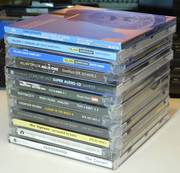
- unsere 16 SACDs querbeet

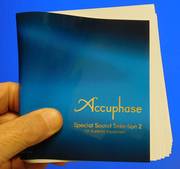
- SACD-Booklet-Beispiel 1

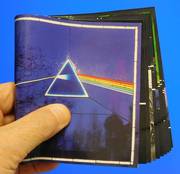
- SACD-Booklet-Beispiel 2

- SACD-Booklet-Beispiel 3

Januar 2026 - Schon bei den etwas teureren 33er Vinyl- Langspiel- Schallplatten der 1960er Jahre war es üblich, dem Käufer und damit dem Hörer mehr Informationen über die Musik zu liefern, die er da gerade hört. Und wenn die Rückseite des vollformatigen 30 x 30cm Covers nicht ausgereicht hatte und auch die Innenhülle bereits beidseitig bedruckt war, hatte man dazu ein mehr oder weniger kleines oder großes "Booklet" in den Umschlag bzw. die Hülle beigelegt.
Bei den vom Format her deutlich kleineren CDs hatt es dann angefangen, zu dieser bereits gekauften CD weitere Musik-Informationen sowie Werbung und ganze Listen des restlichen bereits fertigen Repertoirs mitzuliefern, damit der Kunde noch mehr kaufen sollte.
Auf diesen recht kleinen Booklets stand dann immer öfter drauf, um was für eine Aufnahme es sich handelte. Alle hatten zwar mit DIGITAL geworben und dann waren es in den ersten Jahren nach 1993 doch nur die so bezeichneten "AAD" Umspielungen vorhandener alter analoger Masterbänder aus dem Archiv. Erst später wandelte es sich zu wirklich echten "DDD" Aufnahmen.
Bei den SACDs muß man auch wieder sehr genau hinschaun, was man da für Aufnahmen bekommt und aus welchen Jahren die stammen. Von den Beatles und von Pink Floyd existieren keine digitalen Aufnahmen. Bei den Beatles sind es die 4 Spur Masterbänder der damals ganz neuen 4-Spur Studer Maschinen.
.
Bewiesen ist, daß auf den analogen 24 Spur- oder analogen 48 Spur- Masterbändern qualitativ etwas mehr drauf ist als auf dem Produktions-Band für die 33er Schallplatten und später vermutlich auch auf den 2-kanalig zusammen gemixten CDs. Ob das dann auf einer SACD qualitativ vergleichbar so viel besser ist als die CD-Version, soll ja unser Vergleich zeigen.
.
Darum betrachten wir einige SACD Booklets mal etwas genauer ......
Nur in den wenigsten Booklets steht mehr über die benutze Digital-Technik, weil es den Käufer überwiegend gar nicht interessiert und er allermeist mit den Bezeichnungen der technischen Geräte nichts anfangen kann. Für uns, die wir die Entwicklung der analogen Vielspurtechnik in der analogen Endzeit der großen Boliden um 1988 und den Übergang zur digitalen DASH- Magnetbandtechnik mitbekommen hatten, sind solche Infors schon interessant.
Auch diese DASH- Technik lebte nicht lange und die reine Computer basierende Vielspur-Digitaltechnik beendete alle diese Magnetband- Entwicklungen. Heute (besser ab 2010) sprechen die Profis weder über den Frequenzgang noch über den Klirrfaktor noch über den Dynamikbereich. Alles ist inzwischen jenseits von "Gut und Böse" und das sogar über mehr als 64 Kanäle.
.
Betrachten wir die Pink Floyd Aufnahme Dark Side of the Moon

Die analoge Vielspur-Aufnahme (angeblich eine Studer A80 Bandmaschine) stammt aus 1973 und wird immer noch als das "Noneplusultra" der Musikgeschichte vermarktet. Die Interpretation ist ganz sicher beeindruckend - doch die technische Qualität ist (nur !) am oberen Rand des Maximums der analogen Technik - mitsamt der damaligen DOLBY-Technik, wenn die damals überhaupt eingesetzt wurde.
So gut wie alle "Neuerscheinungen" dieser Aufnahmen aus Konzerten und Studio sind remasterte Versionen der analogen Originalbänder oder von Sicherheits-Kopien davon. Angeblich sei es eine 16-Spur Version der Studer A80 gewesen.
Die SACD Surround-Version erschien erst in 2003, denn die mehrfach angegangene 4-Kanal Quadro Version war mit der CD nicht zu machen. Somit ist die SACD- Qualität beinahe nebensächlich, die Surrond-Technik bei dieser Aufnahme aber im Vordergrund.
Zu bemerken ist jedoch, daß es 2003 bereits 5+1 Surround Aufnahmen auf Audio-DVDs gab. Warum da die SACD- Technik ausgewählt wurde, ist nicht zu ergründen.
.
Auch Mark Knopfler erstellte eine 5.1 Surround SACD
Auf der SACD "Brothers in Arms" wird auch die 5.1 Multichannel Surround Technik in den Vordergrund gestellt. Die Aufnahmen von weit vor 2003 sind vermutlich auch auf analogen Mehrspurmaschinen aufgenommen worden.
Auf der Rückseite der SACD wird deshalb auch von Remastering gesprochen. Bei reinen Digitalaufnahmen ist Remastering gar nicht notwendig. Die künstlich verzerrte Gitarre von Knopfler klingt zwar toll, ist aber kein qualitatives Audio-Wunderwerk. Eine simple Kompaktkassette hätte es da auch getan.
.

.
Die US-Plattenfirma TELARC gab sich da mehr Mühe .....

..... dem Neukunden zu erklären, was es mit der SACD auf sich hatte.
Telarc hatte sich in den 1970ern zusammen mit Sheffield Labs auf dem analogen Vinyl-Schallplattenmarkt einen Namen gemacht mit den ersten überragend klingenden "Direct Cut"- 33er Langspiel-Platten.
Später gab es auch CDs von diesen angeblich einmaligen Aufnahmen, wobei dann raus kam, sie hatten doch ein digitales Studiobandgerät mitlaufen lassen - das hatten sie zwar zuerst abgestritten - aber dann doch (nur) zur Sicherheit mitgenommen - sagten sie in einem Hifi-Magazin.
.
Die SACD-Erklärungen / -Erläuterungen im Telarc Booklet 2002
Die Übersetzung des Booklets kommt auch irgendwann, vorerst hier der englische Original-Text. - Wichtig zum Verstehen ist das Jahr der Erstellung diese SACD als erster SACD-Sampler No.1 in - © 2002. Die SACD wurde zum Ende 1999 aus der Taufe gehoben. Unser viel gelobter Pioneer VSX 859 Multimedia Receiver aus 2001 könnte die 5.1 SACD sehr gut bzw. sogar qualitativ besser decodieren, wenn das hochauflösende 5.1 Surround-Signal am ganz normalen SACD-Player ausgegeben werden könnte. Doch das war damals noch nicht erlaubt.
.
TELARC SACD SAMPLER LEVEL DIFFERENCES (auf der TELARC Seite 2)
Our goal in compiling this sampler was to present the listener with a variety of differing approaches to creating a surround sound experience, using various musical examples.
The selections included on this SACD are presented with no alteration in overall level or dynamic range from the original masters. The apparent levels, therefore, differ greatly from track to track.
Telarc's masters are optimized for maximum peak levels during the recording sessions and in subsequent mastering. When we attempted to match the relative volume between these tracks, we found it significantly degraded the sonic integrity of the original masters, resulting in our decision to leave them alone.
To make it easier to play these unleveled tracks, we chose to group them from loudest to softest. There is roughly a 45% difference in apparent level from the first track to the last so you will undoubtedly want to increase the volume as you play through the disc.
Please note that we have identified the source of each original recording, which has been requested from many of our consumers. We also encourage you to visit our surround website at www.telarc.com/sacd where you will find descriptions from our engineers on each release as to how the surround sound was approached. Your feedback is most welcome via our website or by regular mail.
.
Super Audio Compact Discs (SACD): The Next Generation Music Carrier (auf der TELARC Seite 9)
Die Seiten 3 bis 8 waren mit Werbung für Telarc SACDs gefüllt, die wir hier überspringen.
.
In the constantly changing and rapidly advancing world of recording technology, Telarc continually evaluates the latest developments. Ever since producing its first digital recordings in 1978, Telarc's objective has been to provide the highest quality music reproduction possible.
Now, with the development of the Super Audio Compact Disc™ (SACD), which utilizes the extraordinary Direct Stream Digital™ (DSD) recording technology, the foundation exists to launch a new era of high-resolution and multi-channel recordings.
The new Super Audio Compact Disc format, created by Sony and Philips, provides unprecedented sound quality in stereo and multi-channel surround. To achieve its sonic performance, SACD employs DSD, a radically new digital encoding technology.
DSD samples the musical signal at a phenomenal 2.8 million times a second. The result is an extremely smooth digital waveform with unparalleled frequency response and dynamic range. Telarc is recording all of its projects using the DSD process. The potential benefits of SACD do not stop with its performance.
.
Hinweis auf den zweiten CD Layer der Hybrid SACD
The SACD format supports several disc configurations, including a Hybrid SACD designed to be compatible with the millions of CD players in the market today. Hybrid SACDs actually contain two complete layers of music information.
One layer contains the high density stereo and multi-channel surround DSD recording that can be played in the new generation of SACD players. The other layer is a conventional stereo CD layer, which can play on any CD player which conforms to the Sony/Philips Compact Disc standard.
Super Audio CD/SACD, Direct Stream Digital/DSD, and their logos are trademarks of Sony and Philips.
.
HOW A HYBRID SUPER AUDIO COMPACT DISC WORKS -
(auf der TELARC Seite 10 und 11)
.
- CD LAYER
Even the conventional CD Layer can sound better on a Hybrid SACD. ALL TeLarc's original DSD recordings are directly down-converted to produce the Stereo CD master. The resulting quality is unprecedented in a 16-bit, 44.1kHz sampled Compact Disc. - DSD LAYER
The DSD layer contains the two-channel stereo DSD and multi-channel surround DSD recordings. There is also an Extra Data area reserved for graphics, text and video.. - A hybrid SACD
contains two complete layers of music information - the DSD layer and the CD layer. And yet hybrid SACDs are single-sided just like conventional CDs. The DSD layer is made of a special material, which is designed to reflect or transmit laserlight depending on its wavelength. - SACD players
are equipped with optical pickups that emit a 650 nanometer wavelength laserlight that is reflected by the DSD layer. The optical pickups in all CD players, however, emit a 780 nanometer laserlight which is transparent to the DSD layer, so only the CD layer is read.
.
Recommended SACD System Setup .......
Stereo SACD (auf der TELARC Seite 12)
Two versions of the stereo program are available on this SACD. The high-resolution DSD program represents the best that SACD can offer in stereo and is produced from a dedicated DSD stereo mix. Playback on an SACD player is required.
- • Connect the analog stereo outputs of the player to the analog stereo inputs (or left/right front) of the preamplifier or receiver (See Figure 1).
- • Remember, as with any high-resolution program, the wider dynamic range and frequency response of SACD will place larger demands on your playback system.
- • Adjust the volume accordingly and use caution until you are familiar with the program content.
A stereo PCM program is included on the CD layer of this SACD. With this hybrid layer, the SACD will play as a standard CD on all CD players. Dynamic range and frequency content are the same as any standard CD.
For playback on a CD player, connect the digital-out of the CD player to the digital input of a receiver or preamplifier, or the player's left/right analog outputs to the receiver's left/right analog inputs. The stereo programs will play only on the front stereo channels under normal receiver settings.
- Anmerkung : Kein Wort davon, daß zwar das CD-Signal über "digital out" (beide SPFIF Ausgänge) abgenommen werden kann, das SACD Signal aber nur analog über den integrierten D(/A Wandler des Players ausgegben werden darf.
.
Until 1394 Firewire digital interface is available for SACD players and receivers, DSD digital output from the player "is not possible" !!!.
.
Surround SACD (auf der TELARC Seite 12)
Discrete multi-channel surround is available on this SACD. The DSD high-resolution discrete surround program at 2.8224 mHz contains the best surround quality the SACD format offers.
Playable only on a surround SACD player, this program gives 6 discrete (5.1) channels of surround information, and requires a 6-channel surround playback system for proper reproduction (See Figure 2).
- Anmerkung : Auch hier noch kein Wort davon, daß dazu ganz gezielt nur die 6 analogen Cinch Ausgänge des Player benutzt werden "müssen", denn digital ist es nicht möglich bzw. war es nicht erlaubt.
Connect the left/right-front, left/right-rear, and center/sub-woofer (.1) outputs (die Cinch-Ausgänge des Players) to the corresponding inputs of a discrete surround-capable receiver or preamplifier.
Because of the possible wide dynamic range, this high-resolution surround program requires caution in setting safe playback levels. No further decoding for surround is needed (such as DTS or Dolby Pro Logic), because there is one audio track provided for each of the six speaker channels. - See Surround Loudspeaker Setup for proper setup of the loudspeakers.
.
BEWARE of Home Theater Receivers with DSP (Warum ??)
For the best playback performance use a preamplifier or receiver with an "analog pass-through" circuit. Many multi-channel receiver / preamplifiers provide multi-channel analog inputs that are routed to analog-to-digital PCM converters for Digital Signal Processing control, often at 44.1 kHz.
The signals are then passed on to digital-to-analog converters for the final output to speakers. This "feature" will cause ALL signals, regardless of source, to be no better quality than that of CD playback.
Since you are playing an SACD with a sampling rate 64 times higher that of CD, we recommend using a receiver or preamplifier that passes the multi-channel analog signals through entirely in the analog domain.
Keeping the signal in analog, without any further digital intersteps, will ensure you will be enjoying the full quality of SACD. We further recommend that all "effects" programs be disabled, such as "concert hall," "stadium," "nightclub," etc.
These ambience programs, which are suitable for home video use, will destroy the carefully mixed surround presentation you will find on Telarc Surround SACDs.
.
Hier muß unbedingt kommentiert werden - das war Unsinn - es ist ein Schutzargument
Die damaligen Surround Receiver der gehobenen Gerätekategorien konnten sehr wohl das digitale Surrond-Signal dekodieren und an ihre integrierten Endstufen weiterleiten. Da das aber von SONYs Seite nicht erlaubt war, man hätte den Stream ja auf einen digitalen Recorder aufnehmen können, wird hier davor gewarnt und es werden komische Argumente ins Feld geführt. Tatsache ist jedoch, daß nur die teuren SACD-Player auch die hochwertigen Wandler-Chips eingebaut bekommen hatten, die an den Cinch-Buchsen ein exzellentee analoges Signal ausgeben konnten. Die billigen 200 Euro Player hatten die billigsten Wandler onboard und so klang es analog nicht viel besser als von der CD.
.
Surround Loudspeaker Setup
Surround cinema and surround music playback at home are relatively new concepts, so not surprisingly there are many variations of speaker setup possible.
Discrete surround is most often known as "5.1" and "3/2/1," which refers to five main channels representing (usually) left-front, center-front, right-front, right-rear, and left-rear. The ".1" refers to the 6th channel, which particularly in cinema use is a bandwidth-limited track of low-frequency information only.
.
The two most often used speaker setups for home surround playback are: THX®
In the THX ® format, the surround speakers are dipoles (speakers firing front and back) located on the side walls to the left and right of the listener. THX ® feels this arrangement simulates the commercial cinema experience in which there are several monopole (single direction) surrounds distributed on the rear and side walls.
This setup is fine if you are only watching videos on your home theater system with occasional sound effects and ambience present in the surround channels - but may not be satisfactory for music listening.
Most surround engineers/producers mix with the surround channels somewhat behind the listener rather than to the sides. Dipole surround speakers can give a very diffuse (indistinct) picture of the surround information in the recording. That diffuse character will diminish the directionality and individual mix components that are present in a music-only surround recording.
MATCHING SURROUNDS (auf der TELARC Seite 14)
In 1994 the International Telecommunication Union (ITU) published its recommendation for multichannel sound systems with and without picture. In this setup, all loudspeakers are front-firing only (unidirectional), equidistant from the listener, and lie on a circle with the listener at the center.
The left/right front speakers are 60° apart and 30° from the forward direction. The left/right surround speakers are 140° apart and lie 110° from the listener's position. We use variations of the ITU setup for monitoring at Telarc recording sessions and we recommend this setup for surround music playback. The ITU speaker setup is also compatible with home theater video playback.
.
RECOMMENDED SETUP SUMMARY
.
- ITU speaker setup recommended
- Use 5 matched full-range speakers for best results
- All main speakers should be equal distance from the listener
- Use equal amplification for all channels
- All main speakers should play at equal volume for surround music
- For home cinema (not music) use only, surround channels should play at -3dB
.
SPEAKER DETAILS (auf der TELARC Seite 16)
Main Channels
To achieve the best surround performance from music and video sources, we suggest starting with a minimum of four matched loudspeakers: one pair for the front left and right positions and one pair for the surround left and right positions.
For best playback quality, the speakers should all be full-range with equal and adequate amplification for playing high-resolution audio.
If you are using a "satellite" surround system, i.e., small main channels with subwoofer, get the best system possible within your budget. There are many such systems available.
Center Channel
A center channel loudspeaker that, at the minimum, matches the timbre and character of the front loudspeaker pair should be included. Ideally, it should be equal to the other four main channels.
The center loudspeaker should be recessed in its physical position relative to the front left and right loudspeakers so as to create an arc across the front plane (See Diagram 1). This helps to eliminate center channel build-up that can smear the depth and separation of the left-right front image. Typical cinema use of the center channel is for dialog only. However, music surround mixers will often place lead vocals, solo instruments, and bass and percussion in the center channel. That use places more demand on the center channel speaker and amplifier than cinema audio mixes. Don't discount the importance of a good center channel!
.
LFE / Bass Management
The ".1" channel in a 5.1 or 6-channel mix refers to LFE (low frequency effects) most often employed by motion picture soundtrack producers to emphasize explosions or effects and is usually routed to the subwoofer of the surround system.
This sixth channel may or may not be present on a particular surround music release. Your surround receiver or preamplifier may have "Bass Management." This circuit, when used with main speakers of limited bass response (as in satellite + sub-woofer systems), shifts the low frequencies from the main channels to the sub-woofer channel.
Be aware that most receivers use digital circuits to provide bass management. Passing SACD programs through PCM circuitry may degrade the playback performance. We recommend using a receiver or preamplifier that keeps the signal in the analog domain.
If you are using five full-range loudspeakers, it is recommended that Bass Management be disabled and that the subwoofer level and response be set to best suit your listening room.
In some cases, neither the center nor ".1" channels are used. The selection of the number of channels to be employed in a recording, whether it be 4, 5, or 5.1 (6), is determined by the needs of the music and the creative decisions of the artists and/or recording team.
See Height Channel Note for the alternate ".1" channel use.
.
SPEAKER PLACEMENT
During Telarc recording sessions, all balance, ambient space, and source placement was determined on a carefully set-up and aligned 6-channel loudspeaker monitor system. In order to approximate the original performance or recording experience within your own listening environment, it is important that you know under what conditions the original recording was monitored.
In session, we used four or five matched full-range loudspeakers with equal amplification for each channel, including surrounds. They may have been nearfield or midfield monitors, depending upon the size of the recording control room. Surround speakers were never placed on the side walls. Direct radiating loudspeakers were used all around to best represent important musical information present on all five main channels.
A low-distortion, servo-driven sub-woofer was employed in monitoring the ".1" channel. The subwoofer was located to the front of the mix position and placed for the most even bass response in the room - away from corners or close walls.
Generally, the front left/right loudspeakers are set between 30° and 20° from center. (See Diagram 1) Forming an equilateral triangle, each front speaker is angled to focus at a point about 12" behind the listener's head, or just off each ear.
The left/right surround or rear speakers are each between 110° to 125° from center, thus putting them just behind and to the sides of the listener. The matched center loud-speaker (when used) occupies a recessed location center-front, forming an arc across the front plane. The ideal listening position is the same distance from ALL loudspeaker locations.
If the playback system maintains phase and frequency coherence between all five main channels, one may enjoy a multi-channel music surround playback from many different listening positions, even outside of the direct soundfield reproducing space.
NOTE: To unlock the full potential of the surround program on this SACD follow the Height Channel instructions on the Telarc.com web site: www.telarc.com/surround/default.asp
.
ALIGNMENT (auf der TELARC Seite 17)
To properly align your surround speaker system you will need a setup and alignment disc with pink noise signals provided for each channel.
[Tchaikovsky: 1812 (SACD-60541) includes setup and alignment tracks. For more information, visit the Telarc website at www.telarc.com or call 1-800-801-5810.]
- • Disable reverberation, ambience, or "effects" programs in your surround receiver.
- • Use a sound pressure meter set to C-weighted, slow response, 80dB range (Radio Shack has an SPL meter for about $40).
- • Measure each main loudspeaker cabinet one at a time and from the center of the listening position.
- • Set the playback level of each channel to be of equal volume for music surround playback.
- • For home cinema playback ONLY, set the rear speakers to be 3dB lower than the front channels.
The bass response of many listening rooms is unpredictable, so aligning the sub-woofer level can be difficult. We monitor Telarc recordings with the sub-woofer crossover set to 80 Hz and at 8-10 dB higher than the main channels. You may want to set the sub-woofer level by ear to suit your particular situation.
Lacking a sound level meter, one can attempt to set the pink-noise levels of each channel by ear. Set the playback levels to be relatively equal between all channels - then adjust to your liking when playing the surround music program.
The setup/alignment procedure may seem like a great deal of trouble to you - we can assure you it will be worth the effort. Hearing a great surround music mix on a well-balanced system will put the excitement back in your music listening. You'll hear elements you never knew existed, even in old familiar pieces. When your friends hear your system, they'll say, "/ gotta have that!"
.
A COMPLETE LISTING OF TELARC SACD RELEASES (Seite 18)
(All are DISCRETE MULTI-CHANNEL SURROUND / STEREO / HYBRID unless otherwise indicated **)
.
Telarc SACD Classical Releases
.
- "BALAKIREV / BRAHMS / HAYDN / RACHMANINOFF / TCHAIKOVSKY: In recital - Lang Lang, piano (60524)
- Music of the Beatles: Kunzel / Cincinnati Pops Orchestra / king'singers (60540)
- BERLIOZ: Symphony Fantastique • Jarvi / Cincinnati Symphony Orchestra (60578)
- A Celtic Spectacular: Kunzel / Cincinnati Pops Orchestra / The Chieftains / James Galway / John McDermott (60571)
- DUPRE/FRANCK/WIDOR: The Organ at St. Sulpice • Michael Murray, organ (60516)
- **DUKAS: The Sorcerer's Apprentice /La Peri/Symphony in C • Lopez-Cobos / Cincinnati Symphon Orchestra (60515)
- GOLDSMITH, JERRY: Christus Apollo, original works • Goldsmith / London Symphony Orchestra Anthony Hopkins, narrator (60560)
- GOLDSMITH, JERRY: Film Music of Jerry Goldsmith • Goldsmith / London Symphony Orchestra (60433)
- "HOVHANESS: Spirit of Trees, Concerto for Harp, Sonata, others • Yolanda Kondonassis, harp (60530)
- LAGQ: LATIN: Los Angeles Guitar Quartet (60593)
- MAHLER: Symphony No. 5 • Zander/ Philharmonia Orchestra (60569)
- MAHLER: Symphony No. 6 • Zander/ Philharmonia Orchestra (60586)
- A Mormon Tabernacle Choir Christmas with Orchestra at Temple Square (60552)
- **On Broadway. Les Miserable, The Lion King, Miss Saigon, Rent, and more • Kunzel / Cincinnati Pops (60498)
- ORFF: Carmina Burana • Runnicles/Atlanta Symphony Orchestra and Chorus (60575)
- RACHMANINOFF: Piano Concerto No. 31SCRIABIN: Etudes • Temirkanov / St. Petersburg Philharmonic / Lang Lang, piano (60582)
- Nice 'AT Easy: Celebrating Sinatra / Nelson Riddle arr. • Kunzel / Cincinnati Pops "Big Band" Orchestra (60532)
.
SACD Sampler (60006)
.
- SIBELIUS: Symphony No. 2 in D • TUBIN: Symphony No. 5 in B • Jarvi / Cincinnati Symphony Orchestra (60585)
- The Sound of Glory: Battle Hymn & other Great Hymns of Faith and Inspiration • Mormon Tabernacle Choir / Jessop / Orchestra at Temple Square (60579) **
- Tango! Music of Astor Piazzolla • Rudolf Werthen /1 Fiamminghi (60526)
- TCHAIKOVSKY: 1812 Overture, Capriccio Italien, more • Kunzel / Cincinnati Pops Kiev Symphony Chorus (60541)
- TURINA: Danzas Fantasticas / DEBUSSY: Iberia • Lopez-Cobos / Cincinnati Symphony Orchestra (60574)
- VAUGHAN WILLIAMS: A Sea Symphony • Spano / Atlanta Symphony Orchestra and Chorus / Goerke / Polegato (60588)
.
Telarc SACD Jazz & Blues Releases
.
- ALEXANDER, MONTY: Meets Sly Dunbar and Robbie Shakespeare (63494)
- "ALEXANDER, MONTY: Stir it Up • Reggae (63469)
- ALEXANDER, MONTY: My America (63522)
- BROWN, RAY: SuperBass 2 Live at the Blue Note with John Clayton and Christian McBride (63583)
- "BRUBECK, DAVE: The 40th Anniversary Tour of the U.K. (Recorded Live) Dave Brubeck Quartet (63440)
- CAMILO, MICHEL: Triangulo: Latin Jazz (63549)
- "COLE, FREDDY: Merry-Go-Round (63493)
- LOCKWOOD, JR., ROBERT: Delta Crossroads (63509)
- MAHOGANY, KEVIN: Pride & Joy (63582)
- "McCLAIN, MIGHTY SAM: Blues for the Soul (63487)
- "OSCAR PETERSON, RAY BROWN, & MILT JACKSON; Very Tall Band Recorded Live at the Blue Note (63443)
- PETERSON, OSCAR with MICHEL LEGRAND: Trail Of Dreams - A Canadian Suite (63500)
- "PIZZARELLI, JOHN: Kisses in the Rain (63491)
- PIZZARELLI, JOHN with THE GEORGE SHEARING QUINTET: The Rare Delight of You (63546)
- "TYNER, McCOY: with Stanley Clarke and Al Foster (63488)
- Celebrating the Music of Weather Report (with special guests) (63473)
- WELLS, JUNIOR: Come on in This House (63395)
.
Historic Soundstream Recordings
50kHz Master Transfer to DSD (all STEREO / HYBRID only)
.
- BEETHOVEN: Piano Concerto No. 5 and Symphony No. 5 • Ozawa / Boston Symphony Orchestra (60566)
- MOUSSORGSKY: Pictures at an Exhibition • Maazel / The Cleveland Orchestra (60042)
- ORFF: Carmina Burana • Shaw / Atlanta Symphony Orchestra / Chorus / Soloists (60056)
- SHOSTAKOVICH: Symphony No. 5 /TCHAIKOVSKY: Romeo & Juliet • Maazel /The Cleveland Orchestra (60561)
- STRAVINSKY: Firebird Suite / BORODIN: Polovtsian Dances • Shaw / Atlanta Symphony Orchestra (60039)
- STRAVINSKY: Rite of Spring/ TCHAIKOVSKY: Symphony No. 4 • Maazel /The Cleveland Orchestra (60563)
- VIVALDI: Four Seasons • Ozawa / Boston Symphony Orchestra / Joseph Silverstein, violin (60070)
.
Heads Up SACD Releases
.
- BAILEY, PHILIP: Soul on Jazz (HUSA 9068) SPYRO GYRA: In Modern Times (USA 9061)
"denotes STEREO / HYBRID only Visit telarc.com\sacd for complete details on SACD releases
Compilation Producer: Robert Woods Compilation Editor: Thomas C. Moore SACD Production Supervisor: Erica Brenner
Designer and Art Director: Anilda Carrasquillo
Special thanks to David Kawakami, Gus Skinas, Kobie Crawford, and Tracy Martinson of the Sony "Super Audio CD"- project.
.
Nachsatz und Impressum auf der letzten TELARC Seite 19
To receive up-to-date information from Telarc International Corp., visit our website at www.telarc.com. Register to receive Telarc E-News, the place where you can stay informed about our new releases, upcoming releases, featured promotional giveaways, special offerings, and discounts every month.
For audiophiles interested in our relentless pursuit of the highest quality music and production possible, we offer Audiophile Alerts, a monthly newsletter dedicated to SACD news, upcoming releases, and special announcements.
®© 2002 TELARC* All Rights Reserved
TELARC INTERNATIONAL CORPORATION
.
Nachtrag der Redaktion : Es ist mühsam, die wahren Infos und Daten zusammenzusuchen
Daß das Haupt-Argument von SONY und Philips für die SACD der angeblich nicht knackbare Kopierschutz war, ist inzwischen unbestritten. Als das nächste Argument kam die Surround-Technik, die ja als analoges Quadro-System nie richtig funktioniert hatte. Doch die Musiker und Toningenieure spielten und probierten da vieles aus. Jetzt konnten sie es in die Tat umsetzen, zumal die Plattenfirmen unbedingt neue Produkte brauchten. Die Vinyl-Platte war bereits im Niedergang und die CD war technisch zu klein. Und eine ganz normale Daten-DVD konnte jedermann entschlüsseln und kopieren.
.